HomeLatest NewsFeatured HomebuildersHome Buyer ResourcesBinding ArbitrationResource LinksSubmit ComplaintsView ComplaintsTake Action 101!Report Mortgage FraudMortgage Fraud NewsForeclosure NewsConstruction DefectsHome DefectsPhoto GalleryFoundation ProblemsHomeowner Website Links

Visit HOBB Forums

 BusinessWeek Special Reports
Bonfire of the Builders
Homebuilders helped fuel the housing crisis
Housing: That Sinking Feeling

HOBB-Over 1M visits monthly
Daily Visitors Over 37,000
 Highest Daily66,649

Main Menu
Home
Latest News
Featured Homebuilders
Home Buyer Resources
Binding Arbitration
Resource Links
Submit Complaints
View Complaints
Take Action 101!
Report Mortgage Fraud
Mortgage Fraud News
Foreclosure News
Construction Defects
Home Defects
Photo Gallery
Foundation Problems
Homeowner Website Links
Featured Topics
Report Mortgage Fraud
Foreclosure Special Report
Mold & New Home Guide
Special News Reports
Centex & Habitability
How Fast Can They Build Them?
KBHome Complaints
TRCC Editorial
Texas TRCC Scandal
Texas Watch - Tell Lawmakers
TRCC Recommendations
Sandra Bullock
NEW! KB Defies FTC
KB Stock Down
People's Lawyer
Prevent Nightmare Homes
KB Home vs. kbhomesucks.com
Choice Homes
Smart Money
Weekly Update Message
Old HOBB Site
HOBB Archives
About HOBB
Contact Us
Fair Use Notice
Legislative Work
Your House
Login to Hobb
Welcome Guest.


Lost Password?
No account yet? Register
Search HOBB.org

 HOBB News Alerts
and Updates

Click Here to Subscribe

Support HOBB

Enter Amount:
$

Who's Online
We have 9 guests and 2 members online

Binding Arbitration Bill Filed
SEN. FEINGOLD, REP. JOHNSON INTRODUCE MEASURE TO PRESERVE CONSUMER JUSTICE

Arbitration Fairness Act 2007
See more on: Binding Arbitration plus, Latest News

Legislative Watch
 ACTION ALERT

  Let the Sun Set on the Texas Residential Construction Commission!!
Sunset Public Hearing September 23-24, 2008

See Texas Watch:Texans Abused by Builders, Abandoned by the TRCC
**********

Bill to Watch -
Washington State Homebuyers' Bill of Rights Legislation

San Francisco Chronicle: Builder One Stop Shopping
Friday, 28 March 2008

The Perils of One-Stop Shopping
Like many new-home buyers, lead plaintiff Debbie Bolden had availed herself of the builder's in-house services. KB Homes offered not only in-house real estate agents, but an affiliated mortgage company - in a 50-50 partnership with Countrywide Financial. Countrywide also owned the appraisal company...California builder Ryland Group agreed to refund 850 buyers about $250 each and pay a $161,000 fine after North Carolina's banking commissioner's office accused the builder/lender of using unlicensed loan officers and charging borrowers excessive fees... Altlanta's Beazer Homes, another large builder that began funding its own loans during the boom and has since closed its lending division, is also being investigated by the North Carolina banking commissioner's office for alleged violations of federal lending laws. In 2005 a HUD investigation led to KB Home shelling out a record $3.2 million settlement in response to allegations that the builder's mortgage wing pushed through loan applications that overstated borrowers' incomes.

The Perils of One-Stop Shopping

Like many new-home buyers, lead plaintiff Debbie Bolden had availed herself of the builder's in-house services. KB Homes offered not only in-house real estate agents, but an affiliated mortgage company - in a 50-50 partnership with Countrywide Financial. Countrywide also owned the appraisal company.

It may be years before the facts surrounding Bolden vs KB Homes emerge, but the whole case got me to thinking about the practice of one-stop shopping for new homes.

Compared to buying an existing home wherein a buyer must wander the city with an agent, tour a smorgasbord of houses, then pick a mortgage broker who searches for the right loan from the right lender, which in turn hires an independent appraiser, (tired yet?), new-home buying has become more streamlined.

In the world of new-home purchases, the buyer typically takes a tour of easily comparable model homes, their prices conveniently printed on a brochure. Before making an offer, the buyer is asked to fill out an application with the in-house mortgage broker and lender to obtain loan pre-approval. The in-house lender then arranges for an appraisal and the affiliated title company takes care of the paperwork. Presto, the process is complete without ever going outside the builder's family of businesses.

"One-stop shopping has evolved over the last decade or so," said Joseph Perkins, president and Chief Executive Officer of the Home Builders Association of Northern California, "It's not unlike what's happened in other consumer markets - when you buy a new car, for instance, they also provide the loan. It makes it as easy as possible for the home buyer to complete the transaction. It's a wonderful thing - you do all your business in one place."

Of course, new-home buyers have a right to hire their own agents, and to shop for their own mortgage or title company. But the builders don't always make this choice as attractive. Some builders (especially in a hot market) refuse to pay a commission to outside agents. As a spokesperson for a real estate regulator once told me: "You can be represented by whomever you want, but no builder is required to pay them."

Builders can make choosing the in-house lender, broker and title company appealing in various ways: sometimes they offer extra incentives like a hardwood floor upgrade if you borrow from their affiliated lender. Other times they simply offer interest rates that seem too good to pass up. Besides, when everything is so convenient, many home buyers just don't see the point in chasing down outside lenders or agents.

This is the beauty of one-stop shopping - a process of home buying that simplifies those wretched complications of real estate into an effortless process catering to consumer desires.

When builders become the bank

Yet such in-house real estate services, while remarkably convenient, have come under fire since the mortgage crisis.

  • Earlier this month, California builder Ryland Group agreed to refund 850 buyers about $250 each and pay a $161,000 fine after North Carolina's banking commissioner's office accused the builder/lender of using unlicensed loan officers and charging borrowers excessive fees. According to company spokesmen, Ryland agreed to the settlement to avoid litigation, but did not admit to wrongdoing.
  • Altlanta's Beazer Homes, another large builder that began funding its own loans during the boom and has since closed its lending division, is also being investigated by the North Carolina banking commissioner's office for alleged violations of federal lending laws. In the past year, Beazer's lending practices have also become the subject of investigations by the FBI, the Internal Revenue Service, the Justice Department, the inspector general of the Housing & Urban Development Department and, most recently, the Securities and Exchange Commission.
  • In 2005 a HUD investigation led to KB Home shelling out a record $3.2 million settlement in response to allegations that the builder's mortgage wing pushed through loan applications that overstated borrowers' incomes.

Questionable appraisals

True one-stop shopping also extends to appraisers - another aspect of the business that has recently come under the legal spotlight. As was true in the Bolden vs. KB Home Countrywide case, the builder/lender also often partners with, if not owns, an affiliated appraisal business.

Early this month, New York Attorney General Andrew Cuomo and the federal Office of Housing Oversight announced that the government had come to an agreement with Fannie Mae and Freddie Mac that would effectively drive a wedge between such close appraiser/lender relationships.

As part of the agreement to prevent appraisers from being pressured by brokers or lenders, Fannie and Freddie have vowed not to buy loans made by lenders that have more than a 20 percent stake in its appraisal company. The agreement also dictates that appraisal companies - irrespective of their ownership structure - must operate as separate entities without influence from the lender. It also says that brokers may no longer handpick appraisers, previously a common practice.

But don't sound a cheer just yet. The agreement won't be put into practice until 2009 and many details are yet to be worked out.

Checks and balances

"Inflated appraisals are a problem across the board, again and again, in predatory lending cases," says Mike Hudson, a senior investigator with the Center for Responsible Lending, nonprofit research group that fights abusive lending practices.

"If you're a builder, you need a working relationship with a lender who will push through loans for you. But … when you don't have an independent third party (appraising the property), offering another step in process, you can end up without the checks and balances that you need."

Although appraisers have been complaining about pressure from lenders for some time, recently a group of them took action. More than 10,000 appraisers have signed a petition asking for help in solving the problem of pressure from brokers, lenders and real estate agents to inflate appraisals.

In his recent book "Greed, Fraud & Ignorance: A Subprime Insider's Look at the Mortgage Collapse" former subprime mortgage lender Richard Bitner exposes the ways that the increasingly intimate relationships between appraisal firms and lenders have allowed a huge number of inflated appraisals to slip through the system.

After analyzing five years of subprime loans, Bitner found that 50 percent of his company's appraisals were up to 10 percent overvalued, that 25 percent were between 11 percent and 20 percent overvalued and that 25 percent were overvalued more than 20 percent.

"I spoke to other subprime lenders and they agreed this was standard," he said.

"Basically, the closer the relationship between the lender and the appraiser, the easier it is to manipulate the process - and get any appraisal you needed."

Historically, real estate has needed to address distinct interests: sellers and builders who want the highest possible price, buyers who want the lowest possible price, and lenders, agents, brokers and appraisers, who want a price that ends in a sale. Yet if the in-house lender has little skin in the game because it plans to resell the loans on the secondary market and its partner is a builder facing a sharp downturn in the market, there's plenty of motive for keeping up appearances that the market isn't softening.

In the worst cases - the kind that set off FBI investigations - buyers working with a builder's affiliated lender can get pushed into buying homes they simply cannot afford.

Even when there is no whiff of predatory lending, intimate partnerships between lenders, builders and appraisers can create distortions in the market as a whole. The widely practiced financial incentives that often come with using an in-house lender don't necessarily hurt the buyer. But in a changing market, such incentives can, as they say in "The Wire", "juke the stats."

By offering lower interest rates or covering closing costs, the builder can keep the home's asking price the same or close to it. This mollifies the builder's investors and stockholders. It also soothes the nerves of the next-door neighbor who might have paid full price. Yet such incentives also obscure the true values. Thus, builder-financed lender incentives can make the new-home market less transparent.

The best strategy

Although there's little that individual buyers can do to fix the greater real estate injuries that have driven our economy to the brink of recession , there's plenty you can do when faced with the appealing prospect of a one-stop shopping home buying experience.

As with all real estate purchases, it's usually wiser to use your own agent. In the current market, it's not a problem - many builders are even offering buyer's agents higher than average commissions. This means making sure you bring your agent the very first time you visit a development, because getting a tour from a builder's sales agent may give them a right to represent you (or at least collect a commission from your deal.)

The affiliated lender may indeed have the best rates and the best loans for you, but it also behooves you to shop around for an outside lender - if only for comparison's sake. If using the in-house lender is mostly attractive because it delivers extra incentives, do the math before you sign on the bottom line. Exactly how much are these incentives worth compared to a potentially higher interest rate or sales price?

Finally, if you have any concerns about the accuracy of your home's appraisal, it can't hurt to order a second appraisal of your own. One-stop shop to your heart's desire, but even as you bask in perks and convenience, maintain the vigilance of a conscientious consumer.

Share your thoughts on this story
Add Your Comment           View Comments

martycourson wrote:
Recently, I have noticed at least one east bay developer manipulating the value of the homes by paying a cash rebate into the escrow. Example: the developer pays $50,000 directly into the escrow which acts as a discount on the sales price. The sale goes through and the comparable for valuation purposes is inflated by $50,000. The seller/developer gets the $50,000 back from the escrow company. New buyers (and their appraisers) in the development find the recent comps and - voila - they are inflated. The fact is, you have to tread very carefully when depending on the age-old mainstay of comps to determine value.

Posted 3/28/2008 6:39:33 AM Recommend (4) 

thefahrm wrote:
My opinion of the entire residential real estate industry is that the industry epitomizes dishonest and generally sleazy behavior. According to the folks I know in the industry, it is rife with under the table, secret deals mainly involving kickbacks to real estate agents and brokers from not just appraisers and lenders, but also from home inspectors, title companies, insurance carriers et al. This is an industry that desperately cries out for close supervision and regulation with serious penalties for misbehavior.

Posted 3/28/2008 7:58:44 AMRecommend (8)

missudpat wrote:
The number of national builders already discovered in frauds ranging from inflating appraisals to predatory lending is so far officially three- Ryland, Beazer and KB. The remaining builders also took part in these activities with the worst being D R Horton. The Federal cases being filed against the country's largest builder for everything from tax evasion, TILA, RESPA, federal labor, discrimination and employment law violations is astonishing. Get a PACER account and browse the federal filings.

Posted 3/28/2008 8:09:51 AM Recommend (3)

mnyounger wrote:
Uhh...yeah...can anyone say "regulatory reform?" Forgive me for asking the obvious question: why were these parties allowed to have such incestuous relationships in the first place? And further: why should anyone be shocked and aghast that these relationships spawned conflicts of interest and subsequent fraud? The moral of the story is: when you present businesses and unscrupulous businesspeople with opportunities to make an extra buck by bending the rules, it is inevitable that many will take advantage of said opportunities. The secret is to create regulations ensuring that these opportunities and temptations never arise in the first place. But, as usual, the government at all levels was asleep at the wheel - they couldn't be bothered to take a long-term view (long-term thinking apparently is for sissies and Communists) or dig beneath the surface of a booming housing market.

Posted 3/28/2008 9:15:28 AM Recommend (9)

calcruiser wrote:
With 15 years of real estate valuation and brokerage experience, including a stint where I actually taught appraisal courses, I have a pretty good idea wherein lies the conflict. It seems the only viable alternative, post the FIRREA S&L Scandal of the late 1980s/early 1990s followed by major reform and now this and not more reform of the appraisers but to simply make appraisal a federal government job. That's right, government - no upside - just decent benefits and not having to pay into Social Security. Banks are regulated by the Feds, why not tie the valuation piece to Uncle Sam? Talk about avoiding pressure, these appraisers would have access to all kinds of cool protections automatically.

Posted 3/28/2008 10:37:34 AM Recommend (4) 

malcolm2 wrote:
Having the government appraise homes would just lead to another form of distortion - inflating values for property tax assessment purposes. So I don't think that is realistic. What is needed in this industry is a healthy dose of ethics, backed up by draconian penalties for stepping over the line, particularly on the appraisal side. I've heard many stories in the past few months of appraisers having their arms twisted to produce higher valuations, particularly by the mortgage brokers who give them the work, so that is obviously one area that needs to be reformed. Appraisers need to be totally independent, not at the mercy of the people they work for.

Posted 3/28/2008 11:41:01 AM Recommend (1)

sageworks wrote:
My son and his girlfriend are buying a house in TN. They sent me the appraisal last night. Came in to the dollar on the agreed upon price. A bit strange, don't you think? Not considered in the appraisal was the fact that all the comp houses had landscaping and mature trees. These add 10's of thousands of dollars to the value of a home. I got taken my countrywide when they required I use their appraiser, and now I'm afraid my son and his girlfriend are getting taken by Wells Fargo - or a hungry appraiser.

Posted 3/28/2008 11:45:31 AM Recommend (0)

Reedman wrote:
The problem is the "moral hazard" presented by nothing-down loans to poor people. If the house goes up in value, they flip and pocket the difference, if the house goes down in value, they walk away, and repeat the process. The mortgage brokers work on commission, so they don't care. The realtors work on commission, so they don't care. The banks have figured out that the risks are a lot higher than their 'rocket scientists' thought, and have now stopped making loans (the Fed has dropped their rates to near nothing, but banks haven't changed their mortgage rates, because they simply don't want the business).

Posted 3/28/2008 1:10:04 PM Recommend (0)

elcerritodogmom wrote:
As always, I'm astounded that the writer of this piece, Carol Lloyd, manages to APPEAR to analyze a subject without actually analyzing it. *sigh* It's very telling, to me at least, that the phrase "conflict of interest" doesn't appear until the fourth comment, by mnyounger. "Conflict of interest" sure doesn't appear in the article, even though a lender who *requires* an appraiser to hit the number(s) is putting the appraiser into a conflict of interest position, esp. since the appraisal form has a signature block for the appraiser to sign, saying that this appraisal is based on his/her best professional judgment and not influenced by others. Yes, it's confusing to have a buyer's agent, a seller's agent, an appraiser, a lender, a mortgage broker, and a title company involved in a closing, but having so many pairs of eyes on those documents helps ferret out situations that "one-stop shopping" (known elsewhere as vertical integration and/or monopolization) facilitates.

Posted 3/28/2008 2:13:17 PM Recommend (0)

hobborg wrote:
Will culprits of predatory business crimes ever be held accountable? The extent of schemes to sell houses has only begun. It was KB Home, its mortgage company and appraisers that began marketing schemes to test the predatory leaning waters in the early 90s. In Texas where builders are unregulated KB implemented 30-year credit card, car and house debt consolidation to increase sales comps and qualify those who did not qualify. When it worked without getting caught, KB expanded the market becoming the benchmark others emulated, creating a booming market of unqualified buyers utilizing inflated appraisals. In 2005 KB Home paid $3.2 million in fines for overstating borrowers' incomes on loan applications. Six builders paid a total of $1.4 Million in HUD settlements as participants in captive title reinsurance with companies owned by builders, lenders, or real estate brokers. These fines only encourage more predatory business practices, as CEOs raked in millions. Janet Ahmad, HOBB.org

  • The Perils of One-Stop Shopping 03/28/2008
  • A Court Case That Could Be A Sign of the Times 03/21/2008
  • Is Suburbia Turning Into Slumburbia? 03/14/2008
  • Think globally, live locally 03/07/2008
  • The dog days of real estate 02/29/2008
  •  
    < Prev   Next >

    Home Builder
     Implode-O-Meter

    Build it right the first time
    An interview with Janet Ahmad

     KB Home Federal Housing Scam
     KB Homes are falling down

    Builders Looking for Federal Handouts

    HUD's Broken System
    From HUD's Deregulation to Disgrace
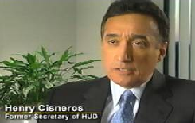
    Did HUD Secretary Cisneros
     Mastermind Predatory Lending?

    KB Home Bombs
    KB Goes Unpunished for Building Community on Bombs
    Taxpayers Pay $2.6 Million
    KB Attempts to Bribe Woman

    KB HOME FEATURES
    Legislators, HUD & FTC
    Respond to complaints
    HUD Fines KB Home$3.2M
    FTC Fines KB Home $2M


    ABC 20/20 - KB Home built on bombs
    KB to build on Worst Nnuclear Meltdown Site
    Why KB Profits are Greater
    Special Reports - Read More...
    See KB Homeowners Protest and Get Results
     WFAA's Bryan Harris Investigates KB Home & Bombs

    Take Action
    Ban Binding Mandatory Arbitration

    Send a message urging your Congressman to support all legislation banning this unfair practice

    TRCC AN ARRESTING EXPERIENCE
    The Pat and Bob Egert Building & TRCC Experience 

    OUTSTANDING FOX4 REPORT
    TRCC from Bad to Worse
    Case of the Crooked House

    Voting Texas Style
    What Lawmaker is Voting for you?

    Give Me Back My Rights Campaign
    Model State Arbitration Legislation
    Fair Homebuyer Contract Model

    Homebuilder's Right-To-Repair Illusion

    Bad Binding Arbitration Experience?
    conttribute@hobb.org
     or call 1-210-402-6800

     Texas, First Home Lemon Law Debated in the Nation

    HOBB Weekly Update Messages

    Texas Watch   
     Tell Lawmakers to Reform Homebuilder Agency
      

    IS YOUR STATE NEXT?
    As Goes Texas So Goes the Nation
    Knowledge and Financial Responsibility are still Optional for Texas Home Builders

    Texas Regulates Homebuyers
     
    Texas Comptroller Condemns TRCC Builder Protection Agency
    TRCC is the punishment phase of homeownership in Texas

    How Texas Home Building Industry shaped the TRCC to regulate buyers 

    NCPIRG
    Homebuyers' Bill of Rights
    Tips for a Better Built Home and to Protect Your Investment

    Drum Major Institute
    for Public Policy

    Tort Deform
    Report Your Arbitration Experience

    Homebuilding Texas Style
    And the walls came
    tumblin' down

     Texas Homebuilder
    Bob Perry Political Contributions

      The Agency Bob Perry Built
     TRCC Connection News
    Tort Reform

    NPR Interview - Perry's
    Political influence movement.
    Click to listen 

    Texas Homebuyers
    Fight for Rights

    TRCC Abolish or Fix
    or Pass Home Lemon Law
    or
    Homebuyers Bill of Rights

    POLICYHOLDERS OF AMERICA POLL
    82% would not vote back in office any legislator, regardless of party, that is soft on bad homebuilders?

    REWARD
    MOST WANTED

    ARIZONA REGISTRAR OF CONTRACTORS
    Have you seen any of these individuals

    Pulte Homeowner Survey
    Warranty & Mortgage Experience
     Click to participate

    Tort Reform Feature
    Texas Monthly
     Hurt? Injured? Need a Lawyer? Too Bad!

    Special Money Report
    Big Money and Shoddy Construction:Texas Home Buyers Left Out in the Cold
    Read More
    Read Report: Big Money…
    Home Builder Money Source of Influence

    Letters to the Editor
    Write your letters to the Editor

    Homeowner Websites

    Most Read
    top of page

    © 2008 HomeOwners for Better Building
    Joomla! is Free Software released under the GNU/GPL License.