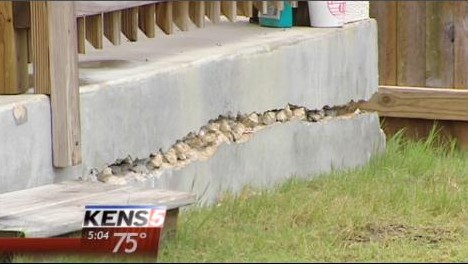
| AUSTIN Arguing before the Third Court of Appeals on Wednesday, a former state chief justice challenged KB Home's attempt to restrain a Kyle couple from publicly protesting about their dissatisfaction with their home.
Alice Oliver-Parrott, former chief justice of the First Court of Appeals, criticized a state district judge for granting what she called an overreaching, vague and unenforceable temporary restraining order.
The order prevents Andrew and Yolanda Brammer and anyone they associate with from directly or indirectly disparaging KB Home in any public forum.
Oliver-Parrott represents the Brammers as their attorney. Whenever there is judicial consideration of an injunction to censure someone, she said, the precedent has been to presume that prior restraint is unconstitutional.
First Amendment rights to free speech and assembly are normally restrained only when there is a threat to peace and safety. The Brammers and several other KB Home customers were picketing earlier this year outside subdivision sales offices.
"There was no trespass charge," Oliver-Parrott said. "There was no ticket written up, there was no threat to peace."
Debby Loomis, attorney for KB Home, attempted to distance her client from parallels Oliver-Parrott drew between the Brammers and failed attempts by Planned Parenthood to restrain abortion protesters.
Although the tactics are similar, Loomis insisted injunctive relief is warranted because the Brammers signed a contract agreeing not to disparage KB Home in exchange for certain repairs and cash compensation.
Loomis said a restraining order was needed quickly because "KB Home has no way of knowing how many people their message is sent to, no way of knowing how many sales they are losing."
Under Texas law, Oliver-Parrott said, no company can get an injunction for an alleged slander or libel, because if a contract exists the proper remedy is to sue for breach of contract.
Justice Bea Ann Smith appeared to agree, commenting to Loomis that, "I don't think I've ever seen somebody try to enforce a contract with an injunction."
Rather than view people who picket about construction defects as on legal parity with abortion protesters, Loomis argued the situation was more like a "domestic violence case" where the law is intent on keeping the protesters from "harassing the victim."
"It's just like a domestic violence case," rebutted Oliver-Parrott, "except it's not domestic and there is no evidence of violence."
Oliver-Parrott asked the court to dissolve the restraining order and send the case back to district court for trial on the breach of contract allegations. A decision is expected later this week.
This e-mail address is being protected from spam bots, you need JavaScript enabled to view it
http://web.archive.org/web/20030919070439/news.mysanantonio.com/story.cfm?xla=saen&xlb=110&xlc=996500&xld=110 |